3 Things We Can Learn from America’s Deadliest Structural Collapse
45 years ago today, in Kansas City, Missouri, 114 people lost their lives because of a tragic engineering mistake.
In July 1980, the hotel chain Hyatt Regency opened a new building. This new hotel had a wonderful, open, expansive lobby with overhead floating walkways crisscrossing it.
Unfortunately, these walkways had a critical design flaw that lay dormant during design and construction. 1 year and 16 days later, on July 17th, 1981, these walkways would collapse during a dance party, falling into the crowded lobby, causing a tragic loss of life.
What can we learn from this?
Lesson #1: Minimize Weakest Links
A structure is only as strong as its weakest link.
The structural engineers designed 1,000 other aspects of this building correctly, but they missed ONE aspect (the weakest link). This weakest link is what caused the tragedy. The only passing grade is 100%.
As an engineer, you have to analyze and evaluate ALL failure modes.
Missing a failure mode can result in a tragedy. It is all or nothing. Nobody gets credit for the other 1,000 ways the building correctly didn’t catastrophically fail.
Each new thing that gets added to the design is something that must be:
designed
analysed
reviewed
purchased
installed
inspected
maintained, etc.
Eliminate the unnecessary.
Each thing eliminated frees up more time, money, and attention for the rest of the project, ensuring those aspects don’t fail.
If the Hyatt Regency Hotel didn’t have floating walkways, there would be no walkways to fail catastrophically. Each thing that is eliminated is something that, categorically, cannot be the thing that failed. Sometimes certain aspects of the design need to be included for performance or aesthetic reasons (e.g., expansive lobby walkways), but make them earn their place.
Ruthless simplification and elimination are the best strategy. Delete everything you can so you can better focus and prioritize the remainder.
Lesson #2: Design for Manufacturing
When you dive into the details of the failed walkway supports, you see they could never have been manufactured. The design was a nightmare for construction from the start.
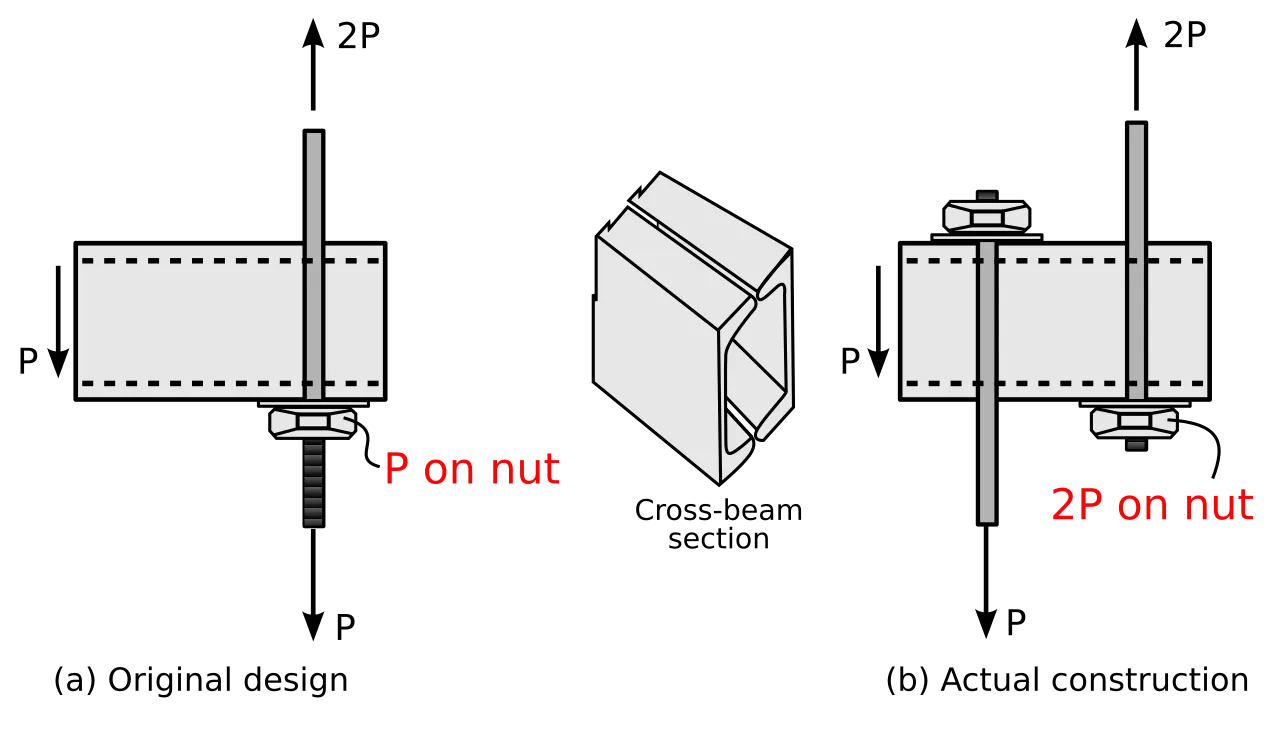
The design for the lobby had two levels of suspended walkways, both attached to the ceiling via 1.25” threaded rods pre-installed and hanging from the ceiling.
The design required a convoluted and strict installation sequence.
A crane would have to lift the 64,000-lb pre-built walkway, perfectly parallel, over 30 vertical feet while aligning 6 rods through 6 holes, all without scratching the threads of the exposed structural threaded rods. THEN, while still suspended in the air, six structural nuts would have to be run up the six threaded rods 30 feet to finally support the dead weight of the walkway. As you might have guessed, this was impossible.
The construction firm, rightly, requested a change order to make the construction feasible. A last-minute change was incorporated, but as a consequence, it accidentally doubled the load on the upper-level walkway.
From a strength perspective, the support design was already too weak. The last-minute construction change doubled the loads, making it seriously underdesigned and dooming the project. The infeasibility of its construction method should have been a red flag to everybody involved.
“Design” is comparatively easy; manufacturing is hard.
If you make a clever design that can’t be manufactured, then you haven't actually designed anything at all. Designs that can actually exist in the physical universe are better than designs that only exist on paper.
The lesson is don’t overlook manufacturing. Good engineers are obsessive about how their parts will actually be built, installed, assembled, and used in the real world.
Lesson #3: Your Signature Matters
Engineers have a responsibility to the public to use their specialized knowledge and skill to make safe designs. The Hyatt Regency disaster is a cautionary tale and a case study in engineering ethics.
The original walkway design was understrength, and this was not found during peer review. The last-minute structural change was approved (over the phone) without performing any calculations on the design's new load capacity. This is two major missed opportunities that resulted in the disaster.
When an engineer signs a drawing or a change order, they vouch for the design's integrity and safety. Never sign or approve anything casually or glibly. Engineers have a reputation. Your signatures matter.
I think reputation and trust in engineering will matter even more in the age of AI.
AI is just a tool. It is a useful engineering tool, just like the slide rule and Excel that preceded it. But no tool absolves engineers of their responsibility and duty.
In the world of AI, people still want things designed by humans. As engineering is accelerated, people will still need to be responsible for the output and new designs.
A 1979 IBM training manual famously warned: 'A computer can never be held accountable. Therefore, a computer must never make a management decision.' Here's my update for the age of engineering with AI:
An AI can never be held accountable. Thus, an AI must never make an engineering decision.
When you sign a drawing, you're not just approving a document; you're promising the people who will stand underneath it that they're safe. Don’t take that responsibility lightly.
Now, let's go build.
Russell Newman is an author, engineer, and father to three wonderful children. He is available for select subject-matter consulting for the space, aviation, and energy industry. Reach out to chat!



X
LinkedIn
Facebook
Instagram
Youtube