How to Cool the Planet for $45 Billion
A first-principles case for Stratospheric Aerosol Injection (SAI)
Cooling the entire planet sounds like it should be the hardest engineering problem ever attempted. It turns out a volcano can do it by accident.
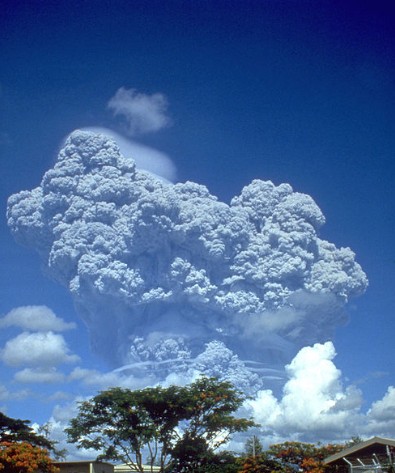
In June 1991, Mount Pinatubo erupted in the Philippines, releasing about 20 million tons of sulfur dioxide into the stratosphere. That sounds like a lot, but humans already pump roughly 75 million tons of sulfur dioxide into the lower atmosphere every year, mostly from burning fossil fuels.
The difference is height.
Pinatubo's sulfur was injected into the stratosphere, where it eventually formed a faint, reflective haze. That faint haze bounced a small fraction of Earth’s sunlight back into space, and for the next year, the whole planet was about 0.5 °C cooler.
Source: Wikipedia (link)
But what if we did this intentionally, gently, and reversibly, instead? This is the idea behind Stratospheric Aerosol Injection, or SAI. SAI lets us have the benefits of the volcano (the cooling effects of stratospheric sulfur) without the downsides of a volcanic eruption (the violent eruption, lava, and all).
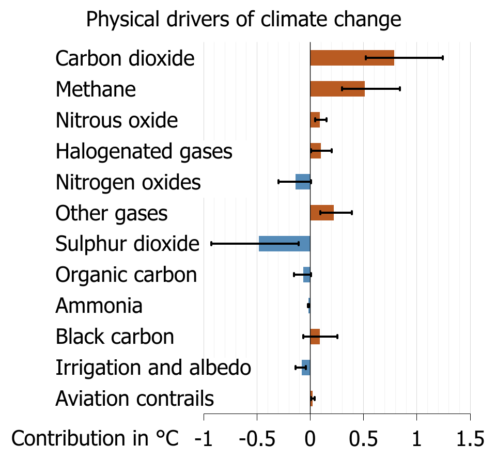
Sulfur Dioxide (SO2) is a good anti-greenhouse gas. This isn't really a fringe claim. This is reconfirmed each time there is another volcanic eruption. The chart below is the mainstream ledger of what gases heat and cool the planet. Almost every gas warms the planet. Sulfur Dioxide is one of the rare entries that has a cooling effect.
Source: Climate Change
The cooling effect of sulfur dioxide has significant leverage for positive human geoengineering. One gram of sulfur dioxide, placed at 20 km - about twice as high as a cruising airliner - offsets the warming effect of roughly 1,000 kg of carbon dioxide for a year. That is a million-to-one leverage. Unlike CO2, which sticks around for centuries, SO2 washes out of the atmosphere after about a year, allowing humanity to more easily control its concentration and the magnitude of its cooling effect.
To cancel about 1 °C of warming, you only need to increase how much sunlight the Earth reflects - its albedo- by about 0.4%. This would be like adding a planet-sized 700,000-gigawatt air conditioner. This cooling effect helps everyone on the planet, doesn’t use electricity, and is built from a haze so thin you would never see it.
SAI is not a cure for climate change; it is a way to buy time. It's not a bad idea to add a temporary air conditioner to the planet if the planet is getting too hot. Humans are already doing planet-scale geoengineering. Humans currently add about 36 GT (GigaTons) of CO2 to the atmosphere each year. Plants eat about 5 GT of CO2 each year. Even if we cut emissions to zero tomorrow, it would take the world's plants something like 400 years to reabsorb the ~2,000 gigatons of legacy CO2 we have already emitted.
SAI does not touch that arithmetic. But it is a very good solution for extending the timeline for the transition to green energy, preserving Earth’s ice sheets, coastlines, ocean currents, and weather patterns.
Think of this essay as a sequel to Casey Handmer’s excellent 2023 blog post, “We should not let the Earth overheat!” I, too, don’t want the planet to overheat. I’m deeply passionate about helping the planet and ensuring humanity’s long-term prosperity.
I'll make the case for SAI in three steps:
A different way to think about the risk of SAI.
How to deliver sulfur dioxide at a planetary scale
(for tens of billions of dollars, not hundreds of billions of dollars)How to get a thousand times more atmospheric science out of the project along the way.
What is Actually Risky About SAI?
Ask most people what worries them about spraying sulfur into the stratosphere, and they point at the chemistry. What size will the particles be? How much cooling do you get per gram? What happens if we get the dose wrong?
These are real, serious questions.
But they are not where the project's biggest risks actually concentrate.
There is a name for this type of mistake. In the book The Failure of Risk Management, Douglas Hubbard describes the Risk Paradox: the risks that receive the most careful measurement are usually not the ones that sink the project. We measure what is easy to measure, not what is actually dangerous.
“Many risk-reduction methods focus on easy-to-measure metrics and do not spend time on what is actually risky.”
-Douglas Hubbard.
We pour analysis into whatever is easiest or most familiar to quantify, and leave the harder risks uninspected. It is usually those harder-to-measure risks that kill us.
The riskiest things for you are usually related to topics outside your own domain of expertise. What is inside it rarely bites you - that is exactly where you are the expert after all!
I'm an engineer, so my reflex is to reach for more engineering - and my real blind spots sit in the human and political side, not the hardware. The same trap catches everyone: a scientist reaches for more science, a policymaker for more regulation, and each can miss the failure mode one field over.
The science is hard and essential. But the risk that gets too little attention lies in implementation: building the delivery system.
The risks that get all the attention:
What's the aerosol particle nucleation microdynamics?
What's the real cooling effect per gram of sulfur?
In 15 years, what is the most beneficial amount of SO2 to release?
These are real questions, and real-world experiments will answer them as the project scales.
The risks that are more likely to make or break the project:
How do we prevent "one more study" from delaying the start forever?
How do we deliver SO₂ at a planetary scale? (the real elephant)
How do we pay for it?
The first three risks are unlikely to be fatal to the project, as there are many opportunities to address them before they lead to negative consequences. The last three are the real risks because they are what will actually sink the project if not addressed well, especially in the initial phase of the project. See the good book Industrial Megaprojects for more on how 50% of all billion-dollar projects fail due to mistakes cemented during their conception.
The Science Solves Itself - If We Start
How do we reduce uncertainty in the science of stratospheric sulfur aerosols? We gather more real-world data, not more laboratory experiments. On this point, I fully agree that we should start real stratospheric experiments to gather this data. The teams designing these experiments are doing essential, careful work - my disagreement is only about how we run the play, not whether to run it.
“Action produces information.”
- Paul Graham.
There is an urgency to do this. I am not arguing against performing a global experiment. I recommend we be less nervous about starting it. A volcano is a planet-scale experiment that nature has already run for us, many times over. We are not starting from zero.
The climate models that capture it disagree by about a factor of two. That uncertainty is real and worth taking seriously - but a factor of two is a spread engineers design around all the time, and it's one more reason to instrument the system heavily so the number tightens as we scale.
It is eminently possible to design a very safe and reliable system with a 2x uncertainty factor. Just look at any of the flying airliners with wings built from carbon fiber composites (Boeing 787 Dreamliner). Carbon fiber has about 3x the Coefficient of Variation (CV) in its material strength than aerospace aluminum. Still, the newer airliners that use carbon fiber do not have even the slightest risk of their wings falling off.
So we are not facing the terrifying open-ended question - “Will stratospheric sulfur even cool the planet?” Nature has answered that one: yes. What stays genuinely open is narrower but real: how much cooling we get per gram, how the effects vary with dose and location, and how far we should scale. Those are precisely the questions real-world data resolves. Any negative effects depend entirely on the dosage. Adding 1 kg is trivial to the environment. A trillion kg would be bad and trigger a modern ice age. We don’t want to “over salt the soup.”
The scale of this human geoengineering project needs to increase through about five orders of magnitude (100,000x). We might start with an initial experiment of around 10 Tons/year and grow to roughly 1,000,000 Tons/year as part of a long-term, planet-wide global cooling project.
Along the way towards full-scale operation, scientific uncertainty is steadily retired- and, crucially, much faster than deployment can physically scale.
This means it is very hard to accidentally “overshoot” and deploy too much SAI. There will be ample time to titrate and modulate the amount of sulfur dioxide released as the project matures during the initial decade of operations.
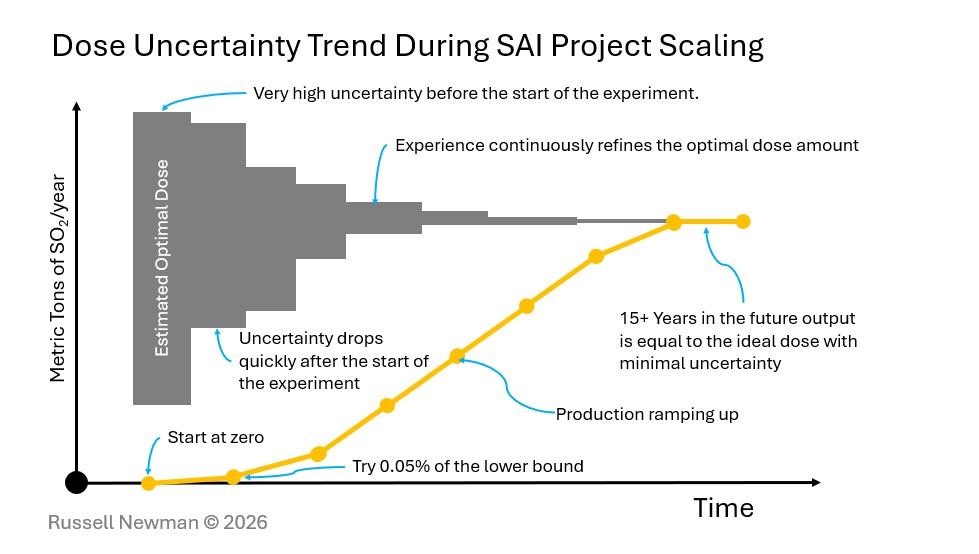
If the initial 10 Tons/year experiments take 2 years to organize, and the project wants to be in full-scale operation within 15 years, it needs to grow at about 160% YoY! Increasing the project's size by 2.6x every year for over a decade is a serious challenge that should not be ignored. Every year that the project delays scaling results in a hotter Earth and requires a larger, more aggressive dose of SAI as a band-aid.
It is tempting to think of this as two distinct phases - an "experiment," and then, later, a "deployment." But they are not two phases. They are a blended continuum. It is a single experiment that never stops, but instead is continuously informed by new data as the program scales through five orders of magnitude. The volume of new scientific data collected each year increases understanding, so the next increment of growth is well known and understood.
Given where we are now, we might not yet know whether the right long-term sulfur dose is closer to a half a million tons or to one million tons per year. But this uncertainty shrinks dramatically as the project scales. One of the largest avoidable risks is locking in a delivery mechanism that can't scale.
Implementation is the Biggest Risk
An honest comparison of delivery systems requires measuring the efficiency of every dollar: how much goes toward actual cooling versus the operational overhead of the delivery method itself.
For that, I'll borrow a tool from Elon Musk: the Idiot Index (link).
The Idiot Index is the ratio of a finished product's cost to the cost of its raw input materials (their commodity prices). The Idiot Index shows how much the product is “marked-up” compared to the theoretical price floor based on the cost of the raw input materials. It is a blunt and wonderful measure of manufacturing efficiency.
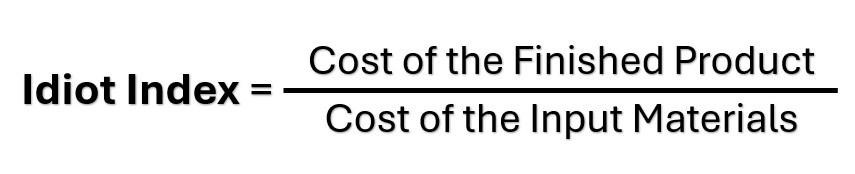
Take paper clips. A thousand of them cost about $9 on Amazon (including shipping), and contain about $3 worth of stainless steel wire. This makes the Idiot Index → $9/$3 = 3. Not terrible.
This means that the $9 paper clips cost $3 for the stainless steel wire and $6 for ALL other manufacturing steps to form, shape, inspect, and package the paper clips, and to ship them to my door, as well as the manufacturer's and distributor's profits, overhead, and marketing, advertising, etc. Paper clip manufacturing is very commoditized and efficient.
If a system is going to scale, it must have a low Idiot Index.
This global project, once kicked off in earnest, might take eight decades to complete. There would be a ramp-up phase (maybe 15 years) where we stabilize the global temperature increase. Then a steady-state phase (maybe 20 years) in which we hold global temperatures constant or slightly decreasing, as society transitions to green energy and synthetic fuel production. Then there would be a taper-down phase (maybe 45 years) during which CO2 levels are decreasing, the environment is recovering, and the project can be transitioned to a successful conclusion.
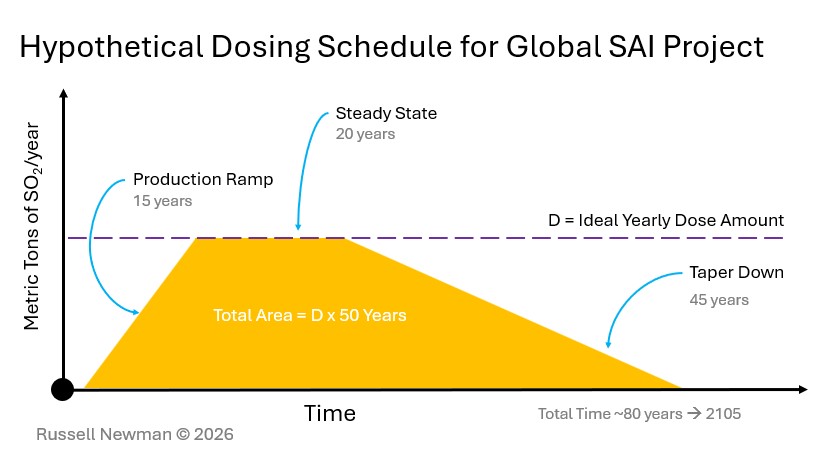
The market price of sulfur dioxide is about $500 per Metric Ton when purchased in bulk. The ideal dosage rate is unknown but is in the ballpark of one million metric tons a year. A million metric tons sounds like a lot, but this would represent only about 5% of the current worldwide annual sulfur production capacity (so we can reasonably assume this won’t significantly affect the price). Under these assumptions, the project would need to deliver about 1 million metric tons of SO2 per year to the stratosphere over a time-weighted average of 50 years at a market price of about $500 per metric ton.
This allows us to calculate the denominator of our Idiot Index as $25 billion.
This is the benchmark. Every dollar over this amount is “overhead” and is money that is not spent on valuable sulfur used to cool the planet.
The Case for Balloons
It would be nice to teleport the sulfur straight into the stratosphere magically. We can’t actually do that, but a simple balloon release system works almost as well.
There is no need to overcomplicate the delivery system.
A one-way, unpowered balloon is almost embarrassingly simple. A thin, 12-micron biodegradable PBAT plastic film filled with a buoyant mix of mostly hydrogen by volume, which easily lifts the heavier sulfur dioxide. This balloon can float to above 20 km, where it can then pop and release its gaseous payload directly into the stratosphere. The balloon film is biodegradable, and the shredded pieces float down and eventually break down within a few weeks to months.
There is no pilot, no engines, no runway, no return trip. Just a simple balloon that floats into the stratosphere and pops within an hour.
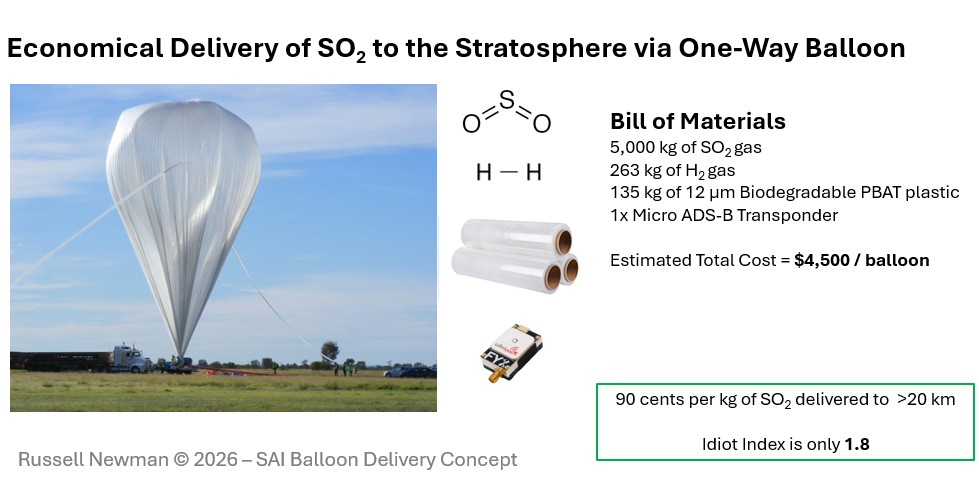
Each balloon would carry a micro 20-gram ADS-B (Automatic Dependent Surveillance–Broadcast) transponder. This is the technology all airplanes and airliners use to avoid each other - so the balloon would appear on every nearby aircraft's collision-avoidance system and on the public tracking network.
The balloon payload would consist only of the trivial tracking electronics attached to the bottom of the balloon (<1 kg). This places it squarely in the exception category of FAA 14 CFR Part 101. This means the regulatory burden for the tracking hardware is low. About 500,000 balloons in this category are already safely released each year globally.
The required ground infrastructure would be minimal-an SO₂ tank and a low-cost electrolyzer to produce buoyant hydrogen gas on-site. There would be PBAT film rolls for creating the balloons. The footprint of this equipment would be small and portable, allowing new deployment sites to be set up nearly anywhere on the globe.
The economics are fantastic. I estimate the marginal cost of one of these balloons at scale is only about $4,500, with about $2,500 worth of sulfur dioxide (5,000 kg) delivered via each balloon. That is an Idiot Index of only 1.8. Less than a dollar of overhead for each dollar of sulfur delivered. These are first-order estimates. The detailed engineering - manufacturing balloons at volume, handling hydrogen and SO₂ safely, and sustaining the launch cadence - is real work. But none of it looks like a physics showstopper, which is the point.
This makes the estimated total lifetime cost of the sulfur delivery program just $25 billion x 1.8 = $45 billion.
While $45 billion represents a significant sum by individual standards, it is a modest investment relative to a global infrastructure project of this importance.
Why Not Just Fly it Up?
The intuitive alternative might be to use an airplane - like the Boeing 747 tankers used to fight wildfires- but dispensing sulfur dioxide at altitude instead of water on a hillside.
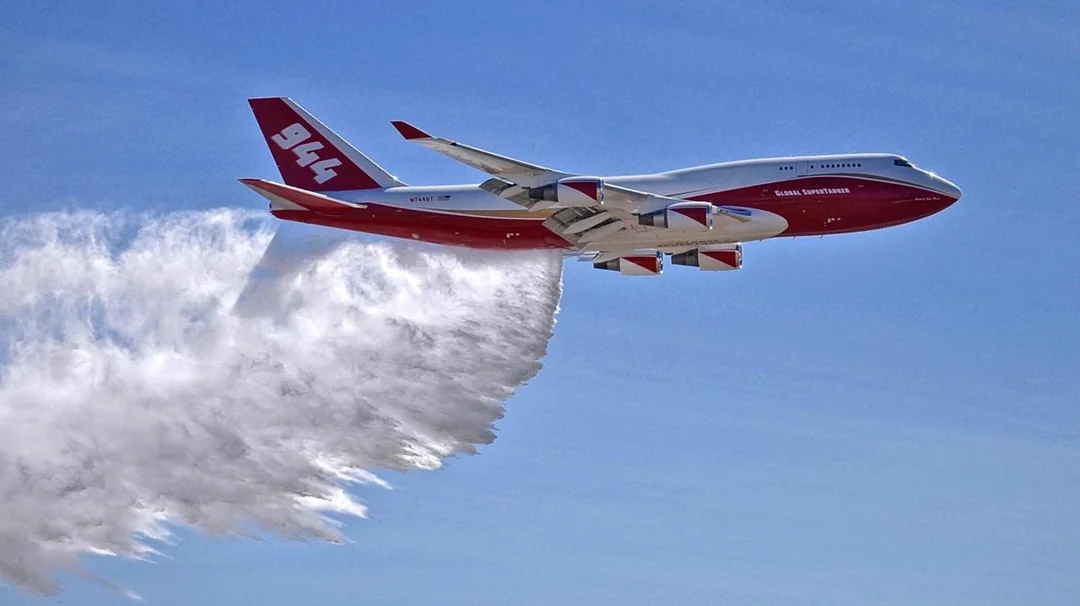
Image Source: Link
I think using airplanes is the wrong answer, for three reasons:
First, they can't reach the right altitude. A Boeing 747 tops out around 45,000 feet (~14 km). That's potentially fine for a demo experiment, but the long-term sweet spot - where the aerosols are more effective and have a longer residence time - is near 65,000 feet (~20 km).
Second, and worse, is certification. The FAA regulatory burden would be astronomical.
Sulfur dioxide is a food preservative in trace amounts, but at 100% concentration it is a toxic gas (Hazard Division 2.3) and corrosive (Class 8). Putting a crewed aircraft full of this chemical into public airspace runs headfirst into FAA regulation 14 CFR 25.1309.
CFR 14 - 25.1309 - Equipment, Systems, and Installations.
The airplane equipment and systems must be designed and installed so that no equipment or system adversely affects the safety of the airplane or its occupants, or the proper function of the airplane. The airplane systems and associated components considered separately, and in relation to other systems, must be designed and installed so that: (1) each catastrophic failure condition is extremely improbable (10^-9) and does not result from a single failure; (2) each hazardous failure condition is extremely remote (10^-7); and (3) each major failure condition is remote (10^-5).
Having been personally responsible for the certification of several different aircraft programs, I can confidently say this regulation, while simple in wording, is very challenging. To demonstrate no catastrophic failure in less than one in a billion flight hours would require superb engineering and a long, detailed, eye-wateringly expensive test campaign.
A Boeing 747 certified to drop perfectly ordinary, harmless water costs around $50 million. I would not expect a Supplemental Type Certificate for a 747 that carries and sprays toxic, corrosive SO₂ to cost less than $500 million and take over ten years, if even possible.
FAA regulation 25.1309 has quietly killed plenty of ambitious aircraft programs - it is far harder to satisfy than it looks on paper.
Third, airplanes are very expensive to own and fly even once certified. As they say in the business, running an airline is a great way to lose a lot of money. The airframe, modification cost, depreciation, crew salaries, crew training, jet fuel, maintenance, turbine engine overhauls, replacement parts, ground support equipment, airport landing fees, hangar rent, ad nauseam.
Adding it up, I estimate that the Idiot Index of SAI via aircraft delivery is about 21. Twenty dollars of delivery for every dollar of sulfur. Not very efficient. The total cost for the sulfur delivery would be around $525 billion. This is nearly ½ a trillion dollars, all to run a single massive fleet of airplanes carrying no passengers.
Balloons Win, and It Isn’t Even Close
When comparing balloons vs airplanes, there is a clear winner. The difference in the Idiot Index (1.8x vs 21x) means the program would save about $480 billion in delivering sulfur to the stratosphere over the program’s lifetime. That is a 91% cost savings.
A balloon is simple enough that your first 10 T experiment and your millionth-ton deployment use the same deployment system, at your ideal target altitude (>20 km).
The regulatory contrast is also stark: today's small-balloon rules are far simpler than the near-impossible aircraft-certification path. (Deployment at full scale would of course draw real oversight - but the starting burden is low, and the underlying physics never changes.)
A cheaper program is also a more fundable one: a $45 billion balloon effort can be backed philanthropically, without imposing a costly new tax on the public. Deploying at planetary scale would still demand broad oversight and legitimacy - but the point is that the hard part becomes the governance, not the hardware.
And the technology isn't ours alone: balloons are within reach of many nations, including India and China, who face the same climate pressures and the same arithmetic. The most useful thing a first mover can do is set the standard - proceed carefully, transparently, and with heavy oversight - so that “doing this responsibly” gets defined by people doing it well. The $45 billion version is easier to fund, easier to scale, and faster to start, and with a ticking climate clock, starting responsibly is most of the game.
Best of all, the $480 billion you don't spend on airplanes is free to spend on something far more valuable: increasing our understanding of what sulfur does once it's up there. That's where I want to go next.
Maximizing the Science by Going to Space
For a project with a potential cost of billions of dollars and a timeline of nearly a century, it is worthwhile to invest in serious scientific infrastructure to help ensure its success. We saved $480 billion by choosing balloons over airplanes. I want to propose spending a tiny fraction of that on the best set of eyes humanity could ask for to understand sulfur dynamics in the upper atmosphere.
Here is the measurement problem from first principles. Every release of sulfur dioxide spreads, over days and weeks, into a plume thousands of kilometers long, drifting and folding based on the stratospheric winds.
Now try to measure it.
Chasing that plume across an ocean with an instrumented aircraft is possible but brutal. Larger station-keeping balloons can only observe a handful of points along its length. There is no guarantee that you can even locate and measure the plume once it diffuses over 1000s of kilometers. No matter what you do, you will only be able to observe a fraction of the total plume volume.
What I would like to do is collect 1000s of times more scientific data!
What if we could measure the sulfur concentration and aerosol size distribution at every voxel in the atmosphere, dozens of times a day, everywhere on Earth at once? With satellites, we can.
Humanity already operates about a thousand Earth-observation satellites that monitor weather and climate with high-accuracy scientific instruments.
What I propose is that we add a new suite of instruments in a satellite constellation, fine-tuned to improve our understanding of stratospheric sulfur chemistry and dynamics. Gaining this capability can be much more economical than most people might realize. So let's build it!
This newly proposed instrument would be similar to NASA's Goddard ARGOS instrument and TROPOMI’s instruments. This new instrument would be two co-aligned modules: 1) a UV imaging camera and 2) a near-infrared (NIR) limb radiometer. Apparently, all spacecraft instruments need acronyms, so I would call this instrument PLUME (Particulate Limb-UV Multispectral Experiment).
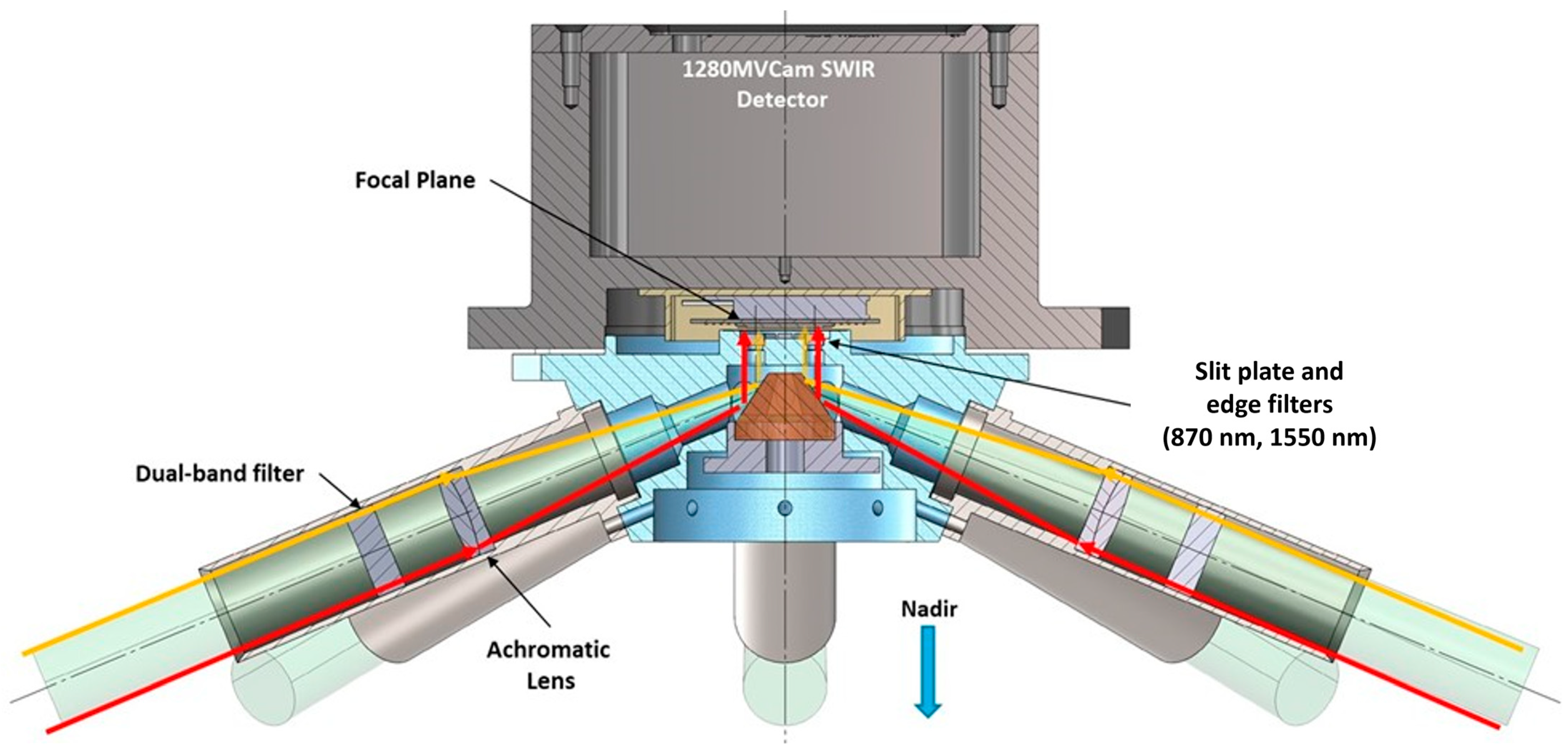
Image Credit: ARGOS Instrument, Deland 2024
The specifics of the PLUME instrument would, of course, require more detailed engineering. But here is my first pass at its capabilities. A UV camera with a four-position filter wheel at 312, 325, 340, and 360 nm. This would help detect and measure sulfur dioxide via differential absorption down to maybe about 1-2 ppb.
The NIR limb radiometer with filters at 870 and 1550 nm could be used to measure sulfate aerosol extinction and particle size distribution. These instruments, co-located, would enable measurement of critical variables for modeling the dynamics of atmospheric sulfur chemistry.
This PLUME instrument does not need to be large. I estimate the whole instrument could weigh roughly 6 kg and draw 20 watts of power. This instrument can be integrated into a commercial small-satellite bus with minimal customization. There are many small satellite bus providers (over 40, for example, on this list), so many that they are almost a commodity. The satellites could be economically launched on SpaceX’s Transporter rideshare missions.
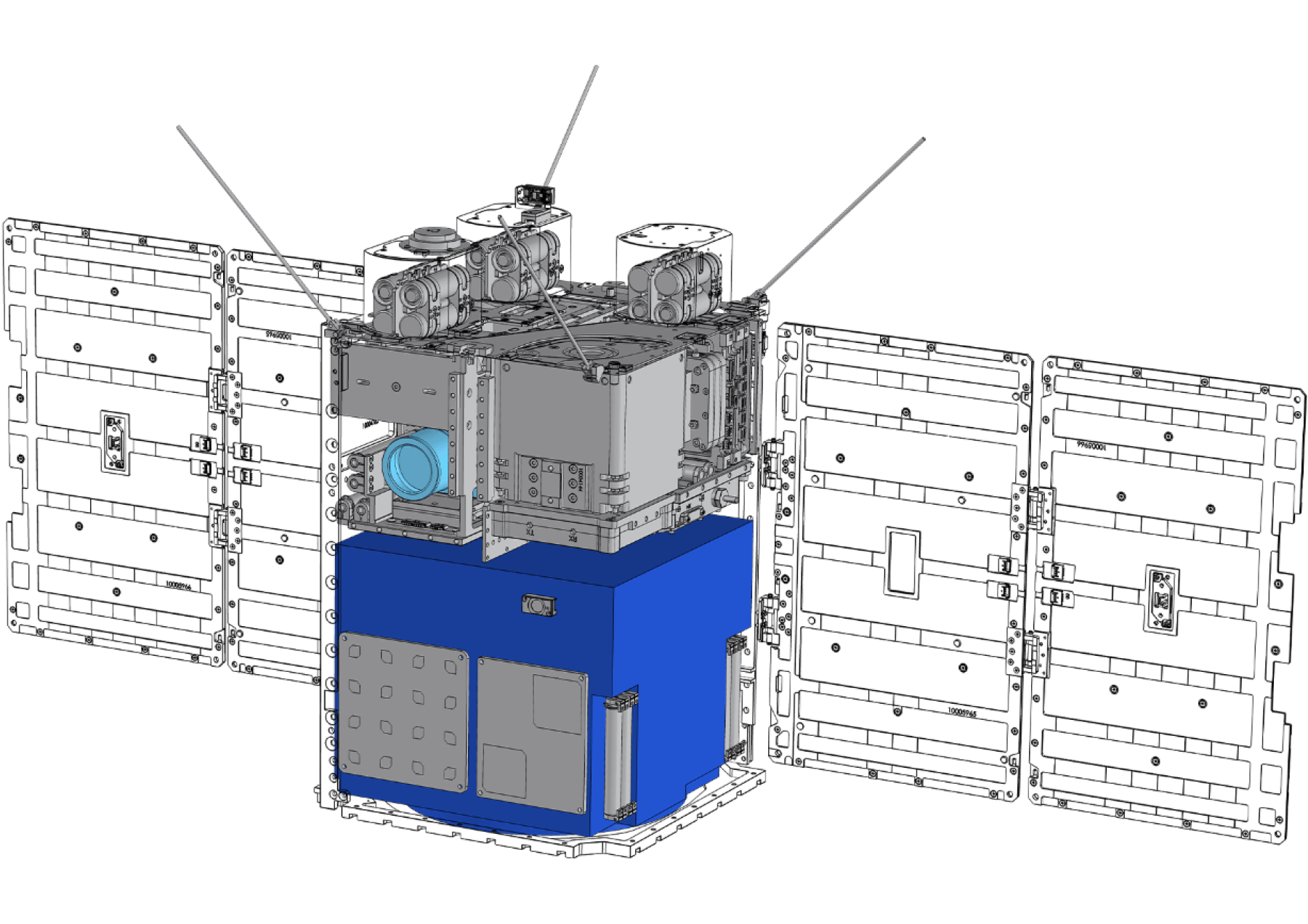
Image Credit: NanoAvionics MP-12P
Here's how I'd roll it out. The first two prototype satellites — the start of what I'd name the Skywatch Constellation - could be built and launched for under $20 million in about two years. Once that development is paid for, each additional satellite costs around maybe $2 million. From there, you build the constellation up over the next few years: about 120 satellites to enable tomographic measurements, plus roughly 40 more in specialty orbital shells that sharpen the spatial resolution and fill in coverage throughout the year. The mature constellation is about 160 satellites across 9 shells, achieving ubiquitous, high-accuracy global coverage.

For a live, interactive version of this animation, visit this link.
You get useful science from the very first satellite. But once the constellation is dense enough, something cool opens up. You can start to perform tomographic scans of every point in the atmosphere about 90 times a day. And all of it can be open-sourced and fed straight into the world's weather and climate models.
To get started with this data collection would cost only $20 million for the demo satellites. First-of-a-kind hardware almost always runs over its first estimate, so I'll deliberately double my own number for margin: call it about $680 million to build the full 160-satellite constellation, plus roughly 10% per year to maintain and refresh it. Even doubled, that's still only about 1.5% of the $45 billion program. I think this would be a worthwhile investment for this ambitious project.
The Skywatch Constellation would provide the world with real-time, global measurements of stratospheric sulfur, its chemistry, and dynamics at every point in the sky. This massive amount of additional scientific data would enable world scientists to understand and monitor the efficacy of the SAI project. This kind of open, real-time data is exactly what the scientific community needs to rigorously evaluate the program - and what would help earn the public's trust.
Conclusion
We started with a volcano that accidentally cooled the planet. Everything in this essay has been about doing the same thing on purpose - cheaply, quickly, and soon. We have the technology and the resources to find out - and, if the evidence supports it, to act. We don't need a miracle; we just need to begin. And I'm ready to help.
Russell Newman is an author, engineer, and father to three wonderful children. He is available for select subject-matter consulting for the hardware industry (especially in space, aviation, and energy). Reach out to chat!



X
LinkedIn
Facebook
Instagram
Youtube